Kitchen Measuring Tools: Cups, Spoons and Digital Scales
Accurate measuring makes recipes easier to repeat, especially in baking where small differences in flour, sugar, liquid or leavening can change the final texture. The most useful kitchen measuring tools are dry measuring cups, liquid measuring cups, measuring spoons and a digital kitchen scale.
Dry measuring cups
Dry measuring cups are designed for ingredients such as flour, sugar, rice and oats. Fill the cup, then level the top with a straight edge when the recipe calls for a level measure.
A Measuring Cups & Spoon Set is useful when a recipe is written in cups and tablespoons rather than grams.
How to measure flour more consistently
For flour, avoid packing the ingredient into the cup unless the recipe specifically tells you to do so. A common method is to spoon flour lightly into the cup and level the top. For the most repeatable result, measure flour by weight with a digital scale.
Liquid measuring cups
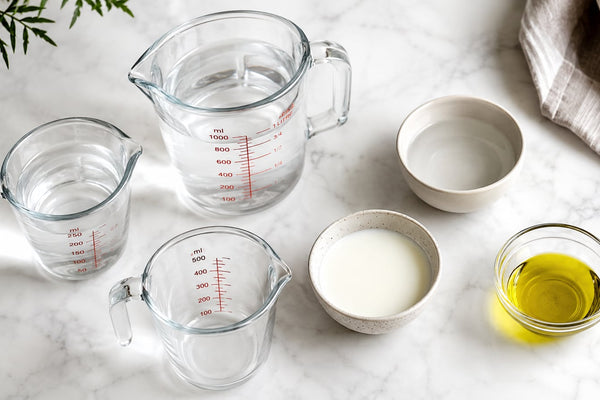
Liquid measuring cups are designed to let you read the volume of water, milk, oil and other liquids while the cup sits on a level surface. Pour the ingredient into the cup, place it on the counter and read the measurement at eye level.
For controlled pouring, a Long Spout Measuring Cup can be useful for batters, sauces, dressings and other liquids that need to be transferred neatly.
Measuring spoons
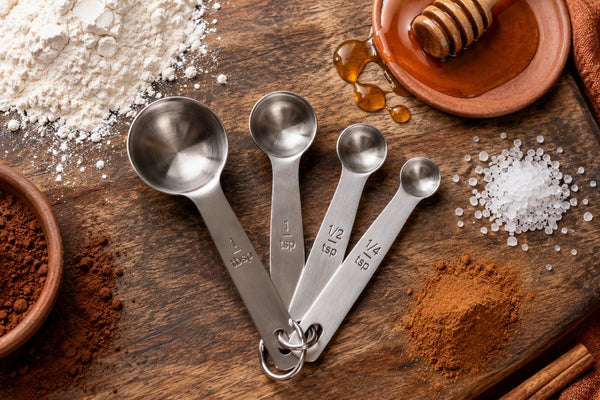
Measuring spoons are useful for small quantities of dry or liquid ingredients such as salt, spices, vanilla, baking powder and oils. When a recipe lists teaspoons or tablespoons, use a measuring spoon rather than an ordinary eating utensil because household spoons vary in size.
For small ingredients that are easier to measure by weight, a Digital Measuring Spoon may also be useful.
Digital kitchen scales
A digital food scale measures ingredient weight directly, usually in grams or ounces. Weight-based measuring is particularly useful for baking, bread, coffee and portioning because it avoids differences caused by how tightly an ingredient is packed into a cup.
Our Smart Digital Food Scale is one option for recipes where measuring by weight is more practical than converting everything to cups.
How to use the tare function
- Place an empty bowl or container on the scale.
- Press the tare or zero button so the display returns to zero.
- Add the first ingredient and record the weight.
- Tare again before adding another ingredient if you want to measure it separately in the same bowl.
Grams vs. cups: which should you use?
Neither system is always “better.” Cups and spoons are convenient for many everyday recipes, while grams are useful when repeatability matters or when a recipe was written by weight. Flour is a good example: the amount that fits in a cup can vary depending on how it is filled, while 125 grams remains 125 grams.
If a recipe gives grams but you only have measuring cups, use our Grams to Cups Converter as a practical reference. Ingredient density matters, so there is no single universal grams-to-cups conversion.
Which measuring tools do you actually need?
- For general cooking: measuring cups and spoons cover most everyday recipes.
- For baking: add a digital kitchen scale for more repeatable ingredient weights.
- For liquids: use a clear liquid measuring cup that can sit level on the counter.
- For very small quantities: measuring spoons or a suitable precision scale can be helpful.
Frequently asked questions
Is a kitchen scale more accurate than measuring cups?
A scale measures weight directly, while cup measurements can vary depending on how an ingredient is packed. For recipes written by weight, a scale generally gives a more repeatable result.
Can I use the same cup for dry and liquid ingredients?
You can measure volume with either, but purpose-designed tools make the process easier. Dry cups are convenient for filling and leveling, while liquid cups are designed to be read while sitting on a level surface.
Why do grams-to-cups conversions change by ingredient?
Grams measure weight and cups measure volume. Different ingredients have different densities, so 100 grams of flour occupies a different volume from 100 grams of honey.
Do I need a digital scale for everyday cooking?
Not necessarily. It is most useful when recipes specify grams, when you bake frequently or when you want more repeatable portion sizes.